Pages

Thursday, February 7, 2013

History of Atari Basketball


I chose to start of Black History Month by giving the history of Atari Basketball. This was the first video game to include a black character.  It was released in 1979 around the time that Atari was releasing a series of sports titles. They were Atari Football, Atari Basketball, Atari Soccer, and Atari Baseball. The unique thing about all of these arcade cabinets is that Atari used its largest ever trackball at 4.5 inches. The basketball game was the only one of the four that was placed in an upright cabinet. The others were in what was known as a cocktail cabinet where you looked down on the screen instead of straight at it. The reason behind this was that unlike the other three games where you were looking down at the field, you watched the basketball game from the sidelines of the court. You were able to play one player versus the computer or against another human player in two-player mode. 

The first black character in a video game
Along with the trackball there is one button, which is used to shoot the ball. The game starts with each player choosing their team. You can either be on the white team or the black team. The ball drops to the center of the court and each player must run there and try to grab it. You may push the button for an extended period of time. Depending on how long you push it, your character will raise the ball over his head and lower it again. The higher it is over the player's head, the farther the ball will go. If you are on the defensive side of the ball, then you can push the button to jump up and block the shot. If you are directly in front of the player with the ball, then you will attempt to steal it. 

Monday, February 4, 2013

The Lion King is My Favorite Thing


If you are one of my friends, it is no surprise to you when I say, "I am a huge fan of Disney." Today I will be talking about one of my favorite Disney movies, The Lion King. It was produced during the Disney renaissance and was one of the last great Disney movies for a few years (not including Toy Story which is considered Disney/Pixar and I do not consider it a part of the Disney animated classics). A little known fact about The Lion King is that it is loosely based on the play Hamlet. 

There is one factor to why I love The Lion King so much and that is Scar. I believe that he by far is the best Disney villain. First of all, Scar's intentions throughout the movie are all based on jealousy. He is envious of his brother who was chosen to be king of the Pride Lands over himself. He becomes even more jealous when Mufasa's son Simba is born because he will be next in line and Scar will have no way to become king. This leads scar to attempt to kill both Simba and Mufasa, which he succeeds in the latter by pushing his own brother off a cliff. He then puts the thoughts into Simba's head that it was his fault that his father died. 

Another reason that I love Scar is that he has a huge following. While most villains have an idiot sidekick, Scar has a whole pack of Hyenas to do his bidding. He promises them that they will never go hungry again and they blindly follow his lead. He could almost be considered the Adolph Hitler of the animal kingdom. This is also where he sings my favorite villain song of all time, "Be Prepared." I have always wanted to play Scar in a production of The Lion King just so I could sing that song. 

I know that I have pretty much turned this post from "The Lion King is My Favorite Thing" to "Scar is My Favorite Thing", but he is the main reason I love The Lion King. I also really enjoy the music in this movie. I do not thing that there is a more recognizable opening to a song. As soon as you hear the Zulu at the beginning of the song, "Circle of Life," you just cannot help but sing along. I looked up the English translation to those words and here they are:

Here comes a lion
Oh yes, it's a lion
There comes a lion
Oh yes, it's a lion
We're going to conquer
It's a lion and a tiger

The English words are definitely not as exciting as the Zulu words. 

These are the reasons that I love The Lion King. It is up there with Aladdin and Beauty and the Beast as my favorite Disney movie. I would recommend that if you have never seen the movie (all three of you) then go and see it. It was truly the end of an era of great Disney movies. 

I also want to give a quick shout out to The Lion King video game on SNES. It is, by far, one of the hardest video games I have ever played. I had it when I was younger and now I play it on an emulator. Even with the save states, I cannot beat the game. After I asked the question, "What is the hardest video game you have ever played?" on Facebook, it was determined that Disney had some of the hardest games. People said The Lion King, Aladdin, and Toy Story were some of the hardest games they have played. Leave a comment with the hardest game you have ever played. 

Thursday, January 31, 2013

History of Pokemon (Generation 1)


Pokémon Across Japan:

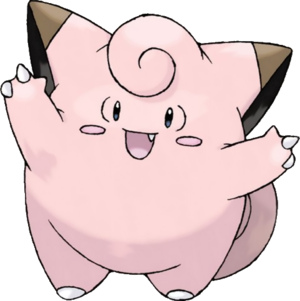
Clefairy, One of the First
Pokemon Created
Pokémon started as an idea that Satoshi Tajiri wanted to base off of his favorite hobby, bug collecting. After coming up with this idea he got the help of his friend Ken Sugimori and they formed Game Freaks and a design studio called Creatures. When Tajiri saw the Game Boy and the Game Boy Link Cable he imagined the bugs traveling across the wire. Satoshi Tajiri created the game Capsule Monsters and pitched it to Nintendo, but was turned down. After other attempts were turned down he got the help of his friend Shigeru Miyamato, the creator of the Super Mario series and the Legend of Zelda series. After that Nintendo decided to fund the project.

For six years Satoshi Tajiri worked on the game and Ken Sugimori worked on the artwork. The first three Pokémon that were created were Rhyhorn, Lapras, and Clefairy. In 1995, sprites of Pikachu, Charmander, Bulbasaur, Squirtle, Meowth, and Mew appeared in Game Boy Camera. They also decided to change the name of the game from Capsule Monsters to Pocket Monsters.

The first Pokemon games, Pokemon Red and Green, came out on February 27, 1996. This allowed children of all ages to catch and train the 150 different monsters that were available in the game. Shortly after Nintendo released Pokemon Blue with updated sound and graphics. Then the Pokemon Trading Card Game was created by Media Factory. It was released on October 20, 1996 and had 102 cards in its first set.

The popularity of the video game and trading card game led to an anime that came out on April 1, 1997. They named the main character of the anime Satoshi after Pokemon's creator, Satoshi Tajiri. The name was changed to Ash Ketchum in the English dub. Sathoshi's rival was named Shigeru, after Shigeru Miyamoto. In English he was named Gary Oak. Along with the anime, Pokémon also released several manga. The most popular being Pokémon Special, which was first published on August 8, 1997.

On April 25, 1998, Pokémon was able to open its own store in Tokyo. This led to other stores being open and there are now six stores in Japan. There was one in New York City, but it has since been shut down and turned into Nintendo World with a section devoted solely to Pokémon.

Pokémon Comes to America:

The United States got its first taste of Pokemon on September 7, 1998 when the first episode of the anime was dubbed into English and released. They also got Pokemon Red and Blue on September 30, 1998. With these releases they also revealed a new slogan, "Gotta Catch 'Em All!" They also released the Trading Card Game on January 9, 1999. It was created by Wizards of the Coast.

While this was going on Japan tried to release a Pokémon game on the Nintendo 64. This game was called Pokemon Stadium, but it only had 42 of the 151 original Pokémon. It was considered very unsuccessful. While this game was a huge flop, the anime was soaring to a huge success. On July 18, 1988, Pokémon: The First Movie was debuted in Japanese theaters. It was followed up with a United States release on November 10, 1999. It would hold the record shortly for highest-grossing opening for an animated film.

Soon, it was decided that they should release a game that was more closely corresponding with the anime. So, Pokémon Yellow Version was released on September 12, 1998 in Japan and October 25, 1999 in the United States. This was very similar to Red and Green/Blue except for that Pikachu is your starter and follows you around outside of his Pokéball. There were also changes to some of the gym leaders lineups and you were able to get all three original starters in the game.

On December 18, 1998, a Game Boy game based off of the Trading Card Game was created. It arrived in North America on April 10, 2000. A year later, in Japan, it was followed up with a sequel titled Pokémon Trading Card Game 2: Here Comes Team GR!. The creators realized that Pikachu was the brands most popular character and they decided to create their own game based off it called Hey You, Pikachu!. This game involved a microphone and allowed the player to interact with Pikachu through voice commands.

This is a picture of Aree and myself at Pokemon
World in Japan
After the anime finished the game's story, it started a spinoff season in the Orange Archipelago, and this sprung a new movie, Pokemon the Movie 2000. With a new take on the series, a game called Pokemon Snap was created on the Nintendo 64. In this game, the player takes control of Todd Snap, a character from the anime, and they go around and take pictures of different Pokémon. There was also another Pokémon spinoff game called Pokémon Pinball on the Game Boy Color. A sequel to Pokemon Stadium was also released. This time in both Japan and the United States. Unlike its predecessor, it had all 151 Pokemon. The stadium series was the first time that audiences could see the Pokémon characters in 3D. Also on the Nintendo 64, Pokémon Puzzle League was released. This was the first Pokémon game that was created strictly for the United States.

Monday, January 28, 2013

The Amazing Spider-Man is My Favorite Thing


Release Date: 2012
Directed By: Marc Webb

Last week I watched the movie, The Amazing Spider-Man, for the first time. I will say that I liked it way more than the first one for a couple of reasons. The main reason is the portrayal of the main character, Spider-Man. I felt that Toby McGuire was trying to hard to have Peter Parker be awkward. The new actor to play Spiderman, Andrew Garfield, plays off this awkwardness so much better. I like the high school crush love interest of Peter Parker/Gwen Stacy rather than the stalkerish love interest between Peter Parker/Mary Jane in the original. 

I really enjoyed learning about the history behind Spider-Man. The start of the movie tells you that this is going to be a darker venture than the first trilogy gave us. The movie starts off with the death of Peter Parker's parents and how he came to live with his aunt and uncle. I really liked how intense they made Uncle Ben's death scene in The Amazing Spider-Man. This tells you that the movie is going to be darker than the previous movies have been. 

I know that a big problem that some people had with Spider-Man 3 is that it had what people dubbed as "Emo Peter." In this movie it was played off as silly and comical, which I do not believe was the intent of the creators. During this movie Peter Parker does go into a state of extreme sadness and depression, but he has all the reason to. He just found the one person that he thinks could solve the mystery of his parent's deaths, his uncle just died and it was partly his fault, and he just got these new powers and is trying to save New York City, but the police are not too fond of him and they issue a warrant for his arrest. 

This leads me into the main reason I loved this movie. Even though it is based on a fictional comic book superhero, it has some realism to it. After Peter Parker becomes Spider-Man he starts targeting criminals that look like the person who killed his uncle. The only problem is that the police do not agree with his actions. They believe that he should leave this work to the police. I think that is what would actually happen if a real superhero popped up in any city. The police would not be thrilled of this person going around doing their work. It makes them look bad because they are expecting a civilian to do their job. 

Those are my thoughts on the film, The Amazing Spider-Man. I actually do not watch a lot of movies, but I really enjoyed this one. I liked the realism of it and how much more down-to-earth it is compared to its predecessor. They really play up the idea that Peter Parker is just a normal teenager trying to fit in and get the girl. 

Thursday, January 24, 2013

History of Monopoly


Monopoly officially started as a game called The Landlord's Game. It was patented in 1904 by Lizzie Magie.  The game was one of the first games that used a continuous path, that means that there were no distinct start and end space. Even though the game was patented, it only existed in homemade versions until it was manufactured in 1906. Magie and two others started the Economic Game Company of New York. In 1910 Magie submitted her game to Parker Brothers, but George Parker refused to publish it. It was eventually published in the United Kingdom by the new company, Brer Fox an' Brer Rabbit. Shortly after Scott Nearing, a professor at the University of Pennsylvania, started using the game to teach classes. 

A new version of the game arose in the 1910s. This game was a shorter version than Magie's because it took out the second round of play. It was known as Auction Monopoly. Magie moved to the Washington D.C. area and got a new patent for her game since the previous one had expired. This time she added named streets to The Landlord's Game. She named a  couple of the streets after real life streets in Chicago. This version of the game also made the rule that higher rent had to be paid if all three railroads and utilities were owned. She also had chips inserted into the game so that they could signify improvements made to properties. Magie again tried to get Parker Brothers to publish her game and again she was denied. 

In the 1920s the game became popular in Reading, Pennsylvania. Former students of Scott Nearing would teach the game to their fraternity at Williams College. They tried to sell copies of the game, but were advised by an attorney not to since it was patented already. In 1932, Daniel Layman, one of the fraternity brothers, brought the game to Indianapolis, Indiana and made a version of the game called The Fascinating Game of Finance. The properties in that game were based on the streets of Indianapolis. The version Layman produces was the first version of the game to use four railroads and chance and community chest cards. 

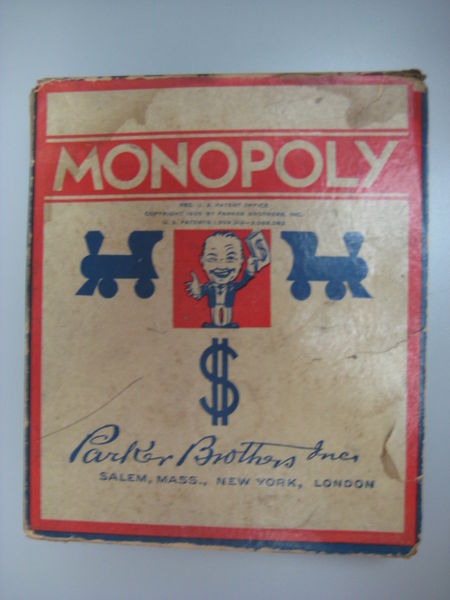
One of the first Monopoly boxes
While in Indianapolis, Ruth Hoskins learned about the game and took it back home with her to Atlantic City, New Jersey. She made her own version of the game and used streets from Atlantic City. Charles Todd learned about the game in Atlantic City and he taught it to Esther Darrow, the wife of Chalres Darrow, the eventual creator of Monopoly. Darrow first made the original games of monopoly by hand with the help of his son, William Darrow. Their sets had all the original places that Charles Todd's version had and even included the infamous misspelling of Marvin Gardens. After demand for the game increased, he started looking for a printing company to help him with the game. Darrow had the game copyrighted in 1933.

Darrow first took the game to Milton Bradley, but they rejected it on May 31, 1934. He then sent it to Parker Brothers, but they rejected it saying, "it was too complicated, too technical, and it took too long to play." In 1935, they heard about the success of the sales for the game and they scheduled a new meeting in 1935. They decided to buy the game and took out a patent on it. They also bought Magie's version of the game and all other versions so that they could say that they had complete control over it. On the original version of the game there were no icons for community chest or luxury tax spaces. 

Since the beginning of Monopoly, it has become a Worldwide phenomenon. There are over 2000 different versions of the game and $67.7 billion worth of monopoly money is printed each year. It has also available in 43 countries and in 111 languages. There have also been countless video games, computer games, and even a game show based off of the popular board game. 

Monday, January 21, 2013

Betrayal at House on the Hill is My Favorite Thing

Release Date: 2004
Publisher: Avalon Hill
                  Wizards of the Coast
# of Players: 3-6


Ever wanted to face off against Frankenstein's monster? How about battle Dracula? Betraying your friends sound like just another Sunday afternoon? This game has all that and more. You start off the game by choosing your character. There are six character pieces that come with the game, and therefore there are six character cards. Each character card has two sides. On each side is a separate character. Depending on which stats you like better, you can choose either character. The four stats that each character has are might, speed, sanity, and knowledge. Each of those stats are used for making specific rolls of the dice. The dice in this game are specialized. They are normal six sided dice, but the sides consist of two ones, two twos, and two blank sides. Next to start the game you must make sure that you shuffle all the decks of cards. There are events, items, and omens. Then go through the room stack and find the entrance hall/foyer/grand staircase, upper landing, and basement landing. Those rooms are already placed in the house.

A room tile with an omen marking
Place all characters in the entrance hall and you are ready to start the game. The player's character who has the next birthday is the first to go (the birthday can be found on the character cards). They are aloud to move as many rooms as their speed. As soon as they come to an unexplored room with a yellow mark on them, they must draw the corresponding card and resolve it and immediately end their turn. If the card, they are suppose to draw is an omen card they must make a haunt roll after they draw the card and do what the card says. With a haunt roll, you roll six dice and you must equal the same number or greater than how many omen cards have already been drawn. For example, if you draw the fifth omen, then you must roll a five or higher or else the haunt will start.

The great thing about this game is that the house you are exploring will never be the same twice. When you go to explore a new room, you draw the top room from the room stack. These rooms say on their back side whether they are a ground floor, second floor, or basement room. Some rooms, such as the pentagram chamber, can only be found on one floor, while others, like the game room, can be found on all three floors. There are also rooms that can only be found on two of the three floors. You enter a new room by walking through a side of a tile with a yellow outline. These signify doors from each room. You then draw a new room and decide which way you want it to face. You are able to block doors by putting a wall with no door against a wall with a door.

All six character pieces
Earlier I mentioned failing the haunt roll. If that happens, then the haunt begins. In that case you open up the traitors tome, one of the three books that comes with game, and loop up the specific room that was found and the specific omen. The book then tells you who the traitor will be. The traitor can range anywhere from no traitor at all, to the haunt revealer, to a specific character, or any other stat. After the traitor is decided then the traitor takes the Traitor's Tome to another room and reads the specific haunt. The other players, now referred to as the heroes, reads the same haunt in the Secrets of Survival handbook. There are fifty different haunts that can happen. The haunts can range anywhere from the heroes having to destroy a certain monster to the traitor having to find a certain item. Each haunt plays so differently that there is plenty of replay value in the game. Even if you end up playing the same haunt again, due to the setup of the house, the results can be very different.

I would say that Betrayal at House on the Hill is one of my all time favorite board games. I love the diversity in each of the haunts and that you do not have a predetermined game board. The board is created as the game goes on. Some haunts seem to favor either the traitor or the heroes, but sometimes this is determined by how many players there are. You can play with anywhere from 3-6 people, but I think that four is the perfect number.

Author's Note: This was all based off of the 2nd edition version of the game since the first edition is no longer in print. There was a huge error made in the first edition where you could find the "Underground Lake" on the second floor.


Tuesday, January 15, 2013

History of Mario

This is a new feature I will be trying on the web site. I will mostly be doing the history of a video game character, but may put a system or game history out once in a while. For the character histories my sections will be history, where I tell about the history of the character, Appearances and Storylines, where I tell about the storylines of their video game sereis, and Games, where I list the games that the character has been in. I explain the cameo appearances.  
First Appearance: Donkey Kong (1981)

History: Shigeru Miyamoto wanted to originally make a video game based on Popeye, Bluto, and Olive Oyl, but was not able to get the licensing to do so. Instead he decided on Donkey Kong, Pauline, and Jumpman. During the early stages of the game, Mario was unable to jump, but Miyamoto decided he should jump. Miyamoto stated, "If you had a barrel rolling towards you, what would you do?" Miyamato then started to refer to his character as "Mr. Video." He did not get the name Mario until Minoru Arakawa, the President of Nintendo of America, was confronted by Mario Segali demanding rent. They decided that since Jumpman looked so much like Segali that his new name would be Mario. 

Mario got his trademark look due to the graphical limitations of the video games of that era. He has a red shirt and blue overalls because it was easy to distinguish between those colors and the background. He was given a hat because Miyamoto did not want to have to worry about his hair style and animating it when he jumped. He also has a big nose and moustache so that they did not have to animate a mouth and all of the facial expressions. 

Miyamato never expected Mario to become as popular as he did. He expected him to be around a long time, but only to be used as cameos. He wanted a character that could be used for any instance. Also, Nintendo has never revealed Mario's full name. Many have declared that it is Mario Mario because of the title of the series being called "The Mario Brothers." The full name has only been used in The Super Mario Bros. Movie and Prima's official Strategy Guide to Mario and Luigi: Superstar Saga. 

Mario Bros.
Appearances and Storyline History: Mario first appeared in Donkey Kong where he is a carpenter and mistreats the ape. The ape eventually escapes and kidnaps Mario (Jumpman's) girlfriend, Pauline. Next came Mario's only time as a bad guy. He was the antagonist during the game Donkey Kong Jr. After Mario's time fighting the apes, he decided that carpentry was too hard for him and decided that being a plumber would be a much simpler life. Thus he brought his younger brother Luigi into business with him and they defended the New York Sewers in the game Mario Bros.

Later on, Princess Toadstool is captured and he must go across the eight worlds of the Mushroom Kingdom and defeat the ruler of the castle and frees the Mushroom Retainer. On his next adventure Mario gets the help of Luigi, Toad, and Princess Peach to defeat Wart with vegetables. This involved going through the characters dreamworld called Subcon. After they get back from Subcon, Peach is again captured by Bowser and Mario and Luigi must save her. This time they have to fight through Bowser's seven children, Lemmy, Iggy, Roy, Morton Jr., Ludwig, Larry, and Wendy, before they finally reach Bowser. 

Super Mario World
In Super Mario Land, Mario must again save a princess. This time it is Princess Daisy of Sarasaland. She is being captured by the evil alien Tatanga. In Super Mario World it is decided that Mario, Luigi, and Peach are in need of some rest and relaxation, so they head to Dinosaur Land for a vacation. While they are there, Peach is again kidnapped, and Mario and Luigi must go and save her. They meet a dinosaur named Yoshi, who becomes there friend, and must battle Bowser's seven children again. In Super Mario Land 2: Six Golden Coins a new antagonist of the Mario series is introduced. In this game, Wario puts an evil spell over the inhabitants of Mario Land and he renames it Wario Land while Mario is in Sarasaland during the first Super Mario Land game. Wario did this so that he could get Mario's castle because he wanted one of his own. Mario must find the six golden coins and take back his land. The next game, Super Mario World 2: Yoshi's Island, is a prequel to the rest of the series. In this game you learn that the stork that brought Mario and Luigi to their parents was attacked by Kamek and he steals Baby Luigi. Mario falls onto Yoshi Island and with the help of the Yoshi's he rescues Luigi.

Mario then made his 3D debut with the release of the Nintendo 64 and Super Mario 64. In this game Peach sends Mario a letter asking him to share a cake with her. Mario arrives at her castle and finds out that Princess Peach was kidnapped by Bowser (surprise, surprise). Instead of a world map, Mario goes to the different levels by jumping through the paintings in the castle. Unlike the other Mario games, Mario faces Bowser multiple times. He must defeat Bowser three times at different points during the game.

Super Mario Sunshine
In Super Mario Sunshine, Mario, Toadsworth, and Princess Peach go on a vacation to Isle Delfino. They soon find out that the area is being vandalized by a Mario lookalike known as Shadow Mario. Mario is blamed for the vandalism and upon his arrival to the island is promptly arrested by the authorities. His punishment is community service and he is ordered to clean up the island. He is given a Flash Liquidizer Ultra Dousing Machine, also known as FLUDD. This was invented by Professor E. Gadd and is used to clean up the island and collect shine sprites. Shadow Mario eventually kidnaps Peach and reveals himself to be Bowser Jr., Bowser's eighth child.

In Super Mario Galaxy, Mario is invited to the centennial Star Festival by Princess Peach. When Mario arrives, Bowser lifts Peach's castle off of its foundation and hurls it into outer space. Failing to protect Peach, Mario meets starlike creatures called Lumas and their caretaker, Rosalina. Rosalina tells Mario that Bowser has stolen the power stars and he has taken Peach to the center of the Universe. Mario then travels to different galaxies to get the power stars and save Princess Peach. In Mario's most recent game, Super Mario Galaxy 2, Bowser turns himself into a giant with the power stars and kidnaps Princess Peach and takes her to the center of the universe again. With the help of the Lumas, Mario pilots the Starship Mario, a planet in the shape of Mario's head, to travel to various galaxies and collect power stars to fuel the ship. He eventually arrives at Bowser's lair and defeats him for the eighth time (not counting the New Super Mario Bros. series.)

Besides helping protect the Mushroom Kingdom from Bowser Mario likes to race go-karts, play tennis, golf, play soccer, play baseball, paint, and various other activities. Some of those activities he even lets Bowser and his minions join in on the fun.

Games: Mario has appeared in 163 Games!
1981-Donkey Kong (Arcade)
1982-Donkey Kong Jr. (Arcade)
1983-Mario's Cement Factory (Game and Watch)
1983-Mario's Bombs Away (Game and Watch)
1983-Pinball (Arcade), Mario and Pauline show up in the bonus stage
1983-Mario Bros. (Arcade)
1984-Mario Bros. Special (NEC PC-8801)
1984-Punch Ball Mario Bros. (NEC PC-8801)
1984-Donkey Kong Hockey (Game and Watch), Mario plays against Donkey Kong
1984-F1 Race (NES), Mario appears at the end of a race circuit
1985-Tennis (NES), Mario is the referee
1985-Baseball (NES),  Mario is the pitcher for one of the teams
1985-Super Mario Bros. (NES)
1985-Wrecking Crew (NES)
1985-Golf (NES, Mario is the golfer
1986-Super Mario Bros. Special (NEC PC-8801)
1986-Super Mario Bros. 2 (Famicom Disk System)
1986-All Night Nipon Super Mario Bros. (Famicom Disk System)
1987-Famicom Grand Prix: F1 Race (Famicom Disk System), Mario is the Player 1 racer
1987-Mario Bros. II (Commodore 64)
1987-Punch-Out!! (NES), Mario is the referee
1988-Super Mario Bros. 2 (NES)
1988-Famicom Grand Prix II: 3D Hot Rally (Famicom Disk System), Mario is the driver
1988-Super Mario Bros. 3 (NES)
1988-I am a Teacher: Super Mario Sweater (Famicom Disk System)
1989-Tetris (NES), Mario appears during the game end screen
1989-Alleyway (Game Boy), Levels modeled after Mario's head and body
1989-Super Mario Land (Game Boy)
1990-Dr. Mario (NES)
1990-Qix (Game Boy), Mario is seen during a cutscene
1990-Super Mario World (SNES)
1991-NES Open Tournament Golf (NES), Mario is the first player golfer
1991-Mario Teaches Typing (PC)
1991-Super Mario Bros. and Friends: When I Grow Up (PC)
1991-Mario the Juggler (Game and Watch)
1991-Yoshi (Game Boy)
1992-Mario is Missing! (SNES)
1992-Supe Mario Kart (SNES)
1992-Super Scope 6 (SNES), Mario appears in a mini game
1992-Mario Paint (SNES)
1992-Yoshi's Cookie (NES)
1992-Super Mario Land 2: 6 Golden Coins (Game Boy)
1992-The Legend of Zelda: A Link to the Past (SNES), Mario appears in some pictures
1993-Mario's Time Machine (SNES)
1993-Mario and Wario (SNES)
1993-Super Mario All Stars (SNES)
1993-Mario's Early Years: Fun with Letters (SNES)
1993-Mario's Early Years: Fun with Numbers (SNES)
1993-Mario's Early Years: Preschool Fun (SNES)
1993-Yoshi's Safari (SNES)
1994-Wario Land: Super Mario Land 3 (Game Boy)
1994-Mario's Playschool (PC)
1994-Hotel Mario (CD-i)
1995-Donkey Kong Country 2: Diddy Kong's Quest (SNES), Mario appears in first or second place
1995-Super Mario World 2: Yoshi's Island (SNES)
1995-Mario's Game Gallery (PC)
1995-Undake 30 Same Game (Satellaview), Mario's head appears as an icon
1995-Mario Excite Bike (Satellaview)
1995-BS Super Mario USA Powr Challenge (Satellaview)
1995-Mario's Picross (Game Boy)
1995-Mario's Super Picross (SNES)
1995-Mario's Tennis (Virtual Boy)
1995-Mario Clash (Virtual Boy)
1996-Mario Teaches Typing 2 (PC)
1996-Super Mario 64 (N64)
1996-Mario Kart 64 (N64)
1996-Super Mario RPG: Legend of the Seven Stars (SNES)
1996-Kirby Super Star (SNES), Mario is in the crowd
1997-BS Mario Paint: Yuu Shou Naizou Ban (Satellaview)
1997-Game and Watch Gallery (Game Boy), Appears in mini games
1997-Game and Watch Gallery 2 (Game Boy), Appears in mini games
1998-Mario no Photopi (N64)
1998-Wrecking Crew '98 (Satellaview)
1998-Super Mario Bros. Deluxe (Game Boy Color)
1998-Mario Golf (N64)
1998-Mario Party (N64)
1998-The Legend of Zelda: Ocarina of Time (N64), Mario appears in a picture
1999-Mario Party 2 (N64)
1999-Super Smash Bros. (N64)
1999-Game and Watch Gallery 3 (Game Boy Color)
1999-Mario Artist: Paint Studio (N64 DD)
1999-Donkey Kong 64 (N64), Unlock original Donkey Kong arcade game
2000-Mario Artist: Talent Studio (N64 DD)
2000-Mario Artist: Communication Kit (N64 DD)
2000-Mario Artist: Polygon Studio (N64 DD)
2000-Mario Tennis (N64)
2000-Paper Mario (N64)
2000-Mario Party 3 (N64)
2000-The Legend of Zelda: Majora's Mask (N64), Mario's face is one of the masks
2001-Animal Crossing (Gamecube), You can buy a Mario statue
2001-Dr. Mario 64 (N64)
2001-Luigi's Mansion (Gamecube), Mario is kidnapped
2001-Super Smash Bros. Melee (Gamecube)
2001-Mario Kart: Super Circuit (Game Boy Advance)
2001-Super Mario Advance (Game Boy Advance)
2001-Super Mario Advance 2: Super Mario World (Game Boy Advance)
2002-Super Mario Sunshine (Gamecube)
2002-Mario Party 4 (Gamecube)
2002-Yoshi's Island: Super Mario Advance 3 (Game Boy Advance)
2002-Game and Watch Gallery 4 (Game Boy Advance)
2003-Mario Party 5 (Gamecube)
2003-Mario Kart: Double Dash (Gamecube)
2003-Mario Golf: Toadstool Tour (Gamecube)
2003-Nintendo Puzzle Collection (Gamecube)
2003-Super Mario Advance 4: Super Mario Bros. 3 (Game Boy Advance)
2003-Mario and Luigi: Superstar Saga (Game Boy Advance)
2004-Paper Mario: The Thousand Year Door (Gamecube)
2004-Mario Party 6 (Gamecube)
2004-Mario Power Tennis (Gamecube)
2004-Mario vs. Donkey Kong (Game Boy Advance)
2004-Mario Golf: Advance Tour (Game Boy Advance)
2004-Mario Pinball Land (Game Boy Advance)
2004-Super Mario 64 DS (DS)
2004-Yakuman DS (DS), Mario is a playable character
2004-Metal Gear Solid: The Twin Snakes (Gamecube), Mario appears as a toy on a computer
2005-NBA Street V3 (Gamecube), Mario is a playable character
2005-Mario Superstar Baseball (Gamecube)
2005-Dance Dance Revolution Mario Mix (Gamecube)
2005-SSX on Tour (Gamecube), Mario is a playable character
2005-Mario Kart DS (DS)
2005-Mario Party 7 (Gamecube)
2005-Super Mario Strikers (Gamecube)
2005-Mario and Luigi: Partners in Time (DS)
2005-Yoshi's Touch and Go (DS)
2005-Mario Party Advance (Game Boy Advance)
2005-Mario Tennis: Power Tour (Game Boy Advance)
2005-Mario Kart Arcade GP (Arcade)
2006-Super Princess Peach (DS)
2006-New Super Mario Bros. (DS)
2006-Mario Hoops 3-on-3 (DS)
2006-Mario vs. Donkey Kong 2: March of the Minis (DS)
2006-Yoshi's Island DS (DS)
2006-Tetris DS (DS), Mario is in the backdrops
2007-Super Paper Mario (Wii)
2007-Mario Party 8 (Wii)
2007-Mario Strikers Charged (Wii)
2007-Mario and Sonic at the Olympic Games (Wii)
2007-Super Mario Galaxy (Wii)
2007-Mario Party DS (DS)
2007-Itadeki Street DS (DS), Mario is a playable character
2007-Mario Kart Arcade GP 2 (Arcade)
2008-Super Smash Bros. Brawl (Wii)
2008-Dr. Mario Express (DSi)
2008-Dr. Mario Online RX (Wii)
2008-Mario Kart Wii (Wii)
2008-Mario Super Sluggers (Wii)
2008-Mario Power Tennis (Wii)
2009-Mario and Sonic at the Winter Olympic Games (Wii)
2009-New Super Mario Bros. Wii (Wii)
2009-Mario and Luigi: Bowser's Inside Story (DS)
2010-Super Mario Galaxy 2 (Wii)
2010-Mario vs. Donkey Kong Mini-Land Mayham (DS)
2010-Mario Sports Mix (Wii)
2011-Super Mario 3D Land (3DS)
2011-Mario and Sonic at the London 2012 Olympic Games (Wii)
2011-Mario Kart 7 (3DS)
2011-Fortune Street (Wii), Mario is a playable character
2012-Mario Party 9 (Wii)
2012-Mario Tennis Open (3DS)
2012-New Super Mario Bros. 2 (3DS)
2012-Paper Mario: Sticker Star (3DS)
2012-New Super Mario Bros. U (Wii U)
2012-Nintendo Land (Wii U)