Pages

Showing posts with label Board Games. Show all posts

Monday, April 15, 2013

Cards Against Humanity is My Favorite Thing


In 1999 a new card game was invented. It was awarded a Mensa Select prizewinner and 1999 Party Game of the Year. This game was Apples to Apples. Now this game is considered a classic family board (card) game up there with Monopoly, The Game of Life, and Scrabble. An issue I have had with my group of friends is that Apples to Apples can get very stale very quickly. You start to notice certain things about the game like, "no matter when you play Helen Keller, it will always be a win." Here is a disclaimer: this game is not Apples to Apples!

Cards Against Humanity took the formula for Apples to Apples and made it fun again. You first start the game by separating the black and white cards. Everyone is then dealt ten white cards. The judge for the first round, in this game they are called the Card Czar, will then flip over a black card. Each player will then throw in what they think is the best white card that fits the black card. The Card Czar then picks the one they like best and the game moves on to the next person to be the Card Czar.

Now, I know that you are thinking, "Man, this is just like Apples to Apples" and in a lot of ways it is. The only difference is that it is geared largely towards adults and the cards are more fun and creative. In Apples to Apples the green cards you flip over are always adjectives and you must find the correct noun that matches the adjective. In Cards Against Humanity the black cards can be fill in the blank or ask a question. Examples are "What is that smell?" and "Sorry professor, I couldn't turn in my homework because of _________." The white cards also are not always kid friendly. Examples of white cards are "Incest", "Hope", and "The Virginia Tech Massacre".

There are also cards that may have you play two cards. An example of this is "Step One:__________, Step Two:__________, Step Three: Profit". There are also two cards in the deck that have you draw two cards at the start of the round, and then you must play three cards. One of those cards say, "Make a Haiku". When this card is played, you must use three of your cards to make a haiku. The haiku does not have to follow 5, 7, 5 format.

The game also has many other rules that you can add. One says that you can sacrifice one of the black cards you won to play two cards into the pile. If you win, you get your card back plus the black card that you won. If you lose, you lose the black card you sacrificed. You can also give up a black card to get rid of any number of white cards in your hand. Also the rules clearly state that you may get rid of a white card if you do not understand what is on the card. The only downfall is that all of your friends may ridicule you for being so naive.

This game may only be bought online at www.cardsagainsthumanity.com. If you do not want to spend the $25 price tag for it, you can also print off all of the cards from the game on their site because the game is in the public domain. Along with the original game there are three expansion packs that cost $10 each.

Thursday, January 24, 2013

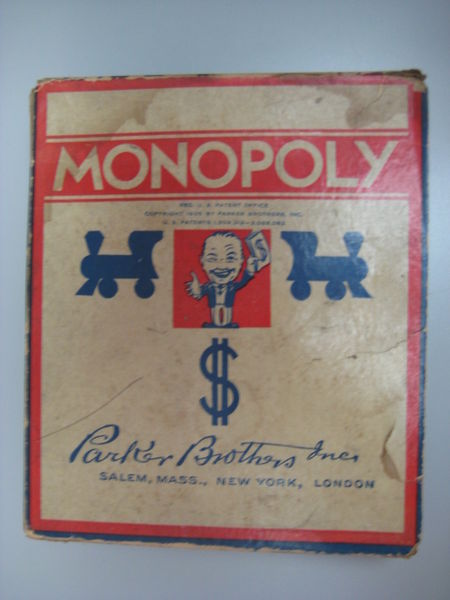
History of Monopoly


Monopoly officially started as a game called The Landlord's Game. It was patented in 1904 by Lizzie Magie.  The game was one of the first games that used a continuous path, that means that there were no distinct start and end space. Even though the game was patented, it only existed in homemade versions until it was manufactured in 1906. Magie and two others started the Economic Game Company of New York. In 1910 Magie submitted her game to Parker Brothers, but George Parker refused to publish it. It was eventually published in the United Kingdom by the new company, Brer Fox an' Brer Rabbit. Shortly after Scott Nearing, a professor at the University of Pennsylvania, started using the game to teach classes. 

A new version of the game arose in the 1910s. This game was a shorter version than Magie's because it took out the second round of play. It was known as Auction Monopoly. Magie moved to the Washington D.C. area and got a new patent for her game since the previous one had expired. This time she added named streets to The Landlord's Game. She named a  couple of the streets after real life streets in Chicago. This version of the game also made the rule that higher rent had to be paid if all three railroads and utilities were owned. She also had chips inserted into the game so that they could signify improvements made to properties. Magie again tried to get Parker Brothers to publish her game and again she was denied. 

In the 1920s the game became popular in Reading, Pennsylvania. Former students of Scott Nearing would teach the game to their fraternity at Williams College. They tried to sell copies of the game, but were advised by an attorney not to since it was patented already. In 1932, Daniel Layman, one of the fraternity brothers, brought the game to Indianapolis, Indiana and made a version of the game called The Fascinating Game of Finance. The properties in that game were based on the streets of Indianapolis. The version Layman produces was the first version of the game to use four railroads and chance and community chest cards. 

One of the first Monopoly boxes
While in Indianapolis, Ruth Hoskins learned about the game and took it back home with her to Atlantic City, New Jersey. She made her own version of the game and used streets from Atlantic City. Charles Todd learned about the game in Atlantic City and he taught it to Esther Darrow, the wife of Chalres Darrow, the eventual creator of Monopoly. Darrow first made the original games of monopoly by hand with the help of his son, William Darrow. Their sets had all the original places that Charles Todd's version had and even included the infamous misspelling of Marvin Gardens. After demand for the game increased, he started looking for a printing company to help him with the game. Darrow had the game copyrighted in 1933.

Darrow first took the game to Milton Bradley, but they rejected it on May 31, 1934. He then sent it to Parker Brothers, but they rejected it saying, "it was too complicated, too technical, and it took too long to play." In 1935, they heard about the success of the sales for the game and they scheduled a new meeting in 1935. They decided to buy the game and took out a patent on it. They also bought Magie's version of the game and all other versions so that they could say that they had complete control over it. On the original version of the game there were no icons for community chest or luxury tax spaces. 

Since the beginning of Monopoly, it has become a Worldwide phenomenon. There are over 2000 different versions of the game and $67.7 billion worth of monopoly money is printed each year. It has also available in 43 countries and in 111 languages. There have also been countless video games, computer games, and even a game show based off of the popular board game. 

Monday, January 21, 2013

Betrayal at House on the Hill is My Favorite Thing

Release Date: 2004
Publisher: Avalon Hill
                  Wizards of the Coast
# of Players: 3-6


Ever wanted to face off against Frankenstein's monster? How about battle Dracula? Betraying your friends sound like just another Sunday afternoon? This game has all that and more. You start off the game by choosing your character. There are six character pieces that come with the game, and therefore there are six character cards. Each character card has two sides. On each side is a separate character. Depending on which stats you like better, you can choose either character. The four stats that each character has are might, speed, sanity, and knowledge. Each of those stats are used for making specific rolls of the dice. The dice in this game are specialized. They are normal six sided dice, but the sides consist of two ones, two twos, and two blank sides. Next to start the game you must make sure that you shuffle all the decks of cards. There are events, items, and omens. Then go through the room stack and find the entrance hall/foyer/grand staircase, upper landing, and basement landing. Those rooms are already placed in the house.

A room tile with an omen marking
Place all characters in the entrance hall and you are ready to start the game. The player's character who has the next birthday is the first to go (the birthday can be found on the character cards). They are aloud to move as many rooms as their speed. As soon as they come to an unexplored room with a yellow mark on them, they must draw the corresponding card and resolve it and immediately end their turn. If the card, they are suppose to draw is an omen card they must make a haunt roll after they draw the card and do what the card says. With a haunt roll, you roll six dice and you must equal the same number or greater than how many omen cards have already been drawn. For example, if you draw the fifth omen, then you must roll a five or higher or else the haunt will start.

The great thing about this game is that the house you are exploring will never be the same twice. When you go to explore a new room, you draw the top room from the room stack. These rooms say on their back side whether they are a ground floor, second floor, or basement room. Some rooms, such as the pentagram chamber, can only be found on one floor, while others, like the game room, can be found on all three floors. There are also rooms that can only be found on two of the three floors. You enter a new room by walking through a side of a tile with a yellow outline. These signify doors from each room. You then draw a new room and decide which way you want it to face. You are able to block doors by putting a wall with no door against a wall with a door.

All six character pieces
Earlier I mentioned failing the haunt roll. If that happens, then the haunt begins. In that case you open up the traitors tome, one of the three books that comes with game, and loop up the specific room that was found and the specific omen. The book then tells you who the traitor will be. The traitor can range anywhere from no traitor at all, to the haunt revealer, to a specific character, or any other stat. After the traitor is decided then the traitor takes the Traitor's Tome to another room and reads the specific haunt. The other players, now referred to as the heroes, reads the same haunt in the Secrets of Survival handbook. There are fifty different haunts that can happen. The haunts can range anywhere from the heroes having to destroy a certain monster to the traitor having to find a certain item. Each haunt plays so differently that there is plenty of replay value in the game. Even if you end up playing the same haunt again, due to the setup of the house, the results can be very different.

I would say that Betrayal at House on the Hill is one of my all time favorite board games. I love the diversity in each of the haunts and that you do not have a predetermined game board. The board is created as the game goes on. Some haunts seem to favor either the traitor or the heroes, but sometimes this is determined by how many players there are. You can play with anywhere from 3-6 people, but I think that four is the perfect number.

Author's Note: This was all based off of the 2nd edition version of the game since the first edition is no longer in print. There was a huge error made in the first edition where you could find the "Underground Lake" on the second floor.


Wednesday, January 9, 2013

Cosmic Encounter is My Favorite Thing


Release Date: 2008
Publisher: Fantasy Flight Games
# of Players: 3-5 (Each expansion also adds one more player)

I am a huge fan of board games and this is one of my favorites.

Cosmic Encounter's story is based around many different alien races trying to take over the galaxy. The creators put a lot of thought into this game because each of the fifty aliens (110 if you have all three expansions) have their own story and information. This is the type of game that if you have get discouraged by huge rulebooks easily, then you will be scared to play this game. Though the rulebook is big, the game is very simple to play at its core. 

Alien Power Card
A
Flare Card
You first start out the game by dealing out two alien power cards called flares. These cards determine which special alien power you will have. You choose one card to be your power, then you discard both cards into the deck. These flares do not tell you what your power is. If you would happen to get a flare card in your hand you do one of two things: if you are that particular alien, you use the super part of the card, if you are not that alien, then you use the wild part of the card. You will have another type of card that tells you specifically what your alien power does. Each player is then dealt eight cards. This is where the game gets simple because it is played in seven phases.


Regroup: During this phase each player can choose to research their technology. Also, the player whose turn it is may choose to take one ship out of the warp if they have any there.

Destiny: The player then draws from the destiny deck. These cards determine who the player is going to attack. They will either draw another players color, a wild destiny, or a special destiny. The special destiny card has them attack either the player with the fewest ships in the warp, most foreign colonies, or most cards cards in their hand. The wild destiny card allows to players to choose who they are going to attack. If a player draws a card of their own color they may choose to either draw another card or attack a player that is in their own home system.

Hyperspace Gate
Launch: After the destiny card, the player then chooses which planet in the other player's home system they are going to attack. The put 1-4 ships on the hyperspace gate and aim it at one of the defending player's home planets.

Alliance: During this phase both main players (the offense and the defense) may ask for allies. They are not required to ask. Each player starting with the person to the left of the offensive player may choose to send either 0-4 ships to either side of the battle. If you ally with the defense and win, you get to draw cards depending on how many ships you gave to the battle. If you ally with the offense and win, you get a foreign colony on the defense's planet you were attacking.

Ships who have lost battles and are in the warp
Planning: During the planning phase each main player must choose a card from their hand to play. They may play either an attack card or a negotiate card. If both players play an attack card, then you need to figure out who won the encounter. Each player adds together their ships in the battle to the card that was played. This includes ships that your ally gave in the battle. For example if the blue player (4 ships) is attacking the red player (2 ships) and the green player allied with the red player (3 ships) this is what could happen. The red player flips over a card that says 10. The blue player flips over a card that says 23. In this instance the red player has 15 (10+2+5) and the blue player has 27 (23+4). The blue player wins and all of the red and green players ships must go to the warp. The blue player then has a foreign colony on the red players home system.
Three Attack Cards and a Negotiate Card

Another card that you can lay down is a negotiate card. If one players lays a negotiate card and another plays lays down an attack card then the side that lays down a negotiate automatically loses, but they may pick cards from the other players hand equal to the number of ships they had in the battle. The allies of the player who laid the negotiate card do not get anything and their ships are sent to the warp.

If both players lay down negotiate cards then they have one minute to make a deal of their choosing. These deals must have monetary values. They can both choose to trade cards or colonies. In this case allies go back to their own colonies and do not receive anything.

Reveal: This is where each main player must reveal which ever card they set out. The players then add up their total number of ships and cards.

Resolution: This is where the battle has already been decided and you clean up the playing area. All losing ships go to the warp, cards go to the discard piles and allied ships either go back to their home colonies or a foreign colony.

Here are some other factors of the game:

Flare Cards: I mentioned these up above. The special thing about these cards are that go back into your hand after you use them, but you may only use a flare once per encounter and only one flare an encounter, so if you have multiple flares in your hand, you must make the decision on which one you may use during the encounter. If you are that particular alien, you use the super part of the card. If you are not that alien, you use the wild part of the card.

Artifact Cards: These are one time use cards. Their are different artifacts that are used in different situations. Some cancel the use of an alien power. Others cancel a card effect (except for negotiates, attack, and reinforcements). There are also other types of artifacts in the deck.

Morph Cards: These are another card you can play rather than attack or negotiate. They change your card into whatever card your opponent played.

A pile of technology cards
Technologies: These are an optional part of the game. At the beginning of the game you may deal out two technologies. Like the alien powers, you pick only one. There is a number in the bottom righthand corner. That is how many ships are needed to complete the power. During each regroup phase (not just your own) you may put one ship on the card. This ship is out of play until you either research your technology completely or disband it altogether. These technologies can range from requiring two ships to nine ships and can add special powers such as draw four cards, reset all hands to eight cards, and even blow up or create another planet.

Alien Powers: This is the part of the game where it gets interesting. At the beginning of the game you choose your alien power. The base game has fifty different powers plus twenty more for each expansion you have (there are three of them). That results in 110 different powers you can have. These powers each have their own uses. For instance, the Macron has each of their ships worth four instead of one, but they may only send one ship per encounter. The Zombie's ships never go to the warp when they lose, but back to their own home colonies. The Remora gets to draw a card every time another player draws a card and gets a ship from the warp every time another player gets a ship from the warp. These are what makes Cosmic Encounter a fun game to play.

This game has a lot of originality to it. Each game is different and that is why I like this. I have found out that it depends on your group of people whether they will have fun or not. I have two groups that I have played this with. One group argues the whole game and we only play once and then we are done. The other group loves the game and we will play over and over again until we have to leave. I would recommend to anyone to try this game out if you see it sitting on a store shelf. I know that Barnes and Noble have the game online and you can also find it on Amazon.